

Weekly Connection #13
Swiftonomics, the Nobel Prize, language learning
I’m back in the Côte d'Azur this week; our pantry is stocked with American condiments from Chicago, the French have resumed la grève (strike action), and the days are slightly cooler. Still, it's not quite the season to wear scarves, and pumpkin-spiced lattes are nowhere to be found!
🏆 Nobel Prize for Economics: Women in Work
Dr Claudia Goldin (Harvard bio) has won the Nobel Prize for Economics for her research on women and work participation, including the gender pay gap, having agglomerated 200 years of American workplace data. One of her findings is that women's educational choices have an unexpectedly lasting impact on their later career options after child-raising or caregiving.
“We see a residue of history around us,” [Goldin] said, explaining that societal and family structures that women and men grow up in shape their behaviour and economic outcomes.
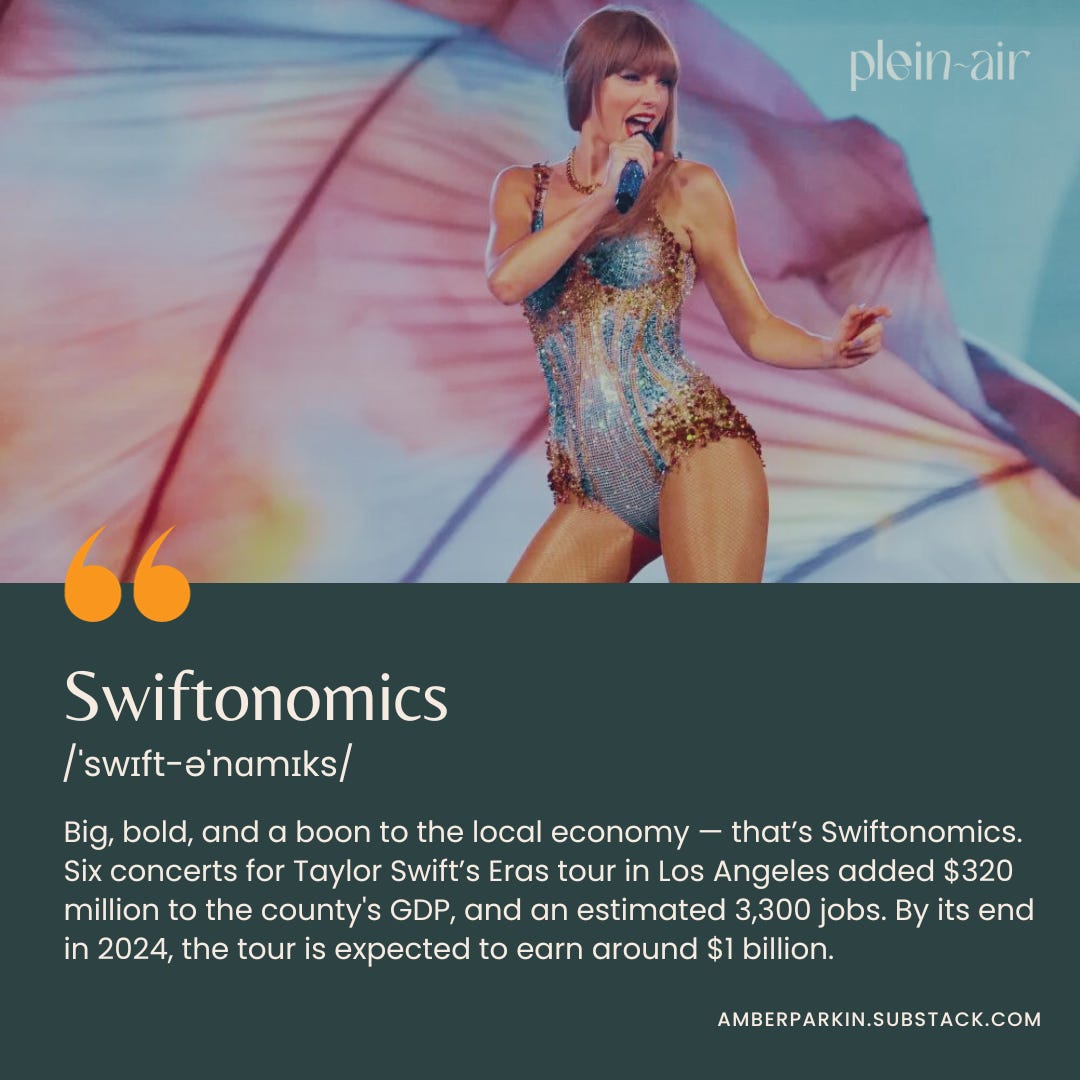
💵 Swiftonomics
Maria Psyllou, an economist at the University of Birmingham, shares an academic take on Taylor Swift’s boon to communities (beyond fans' happiness), Taylor Swift's Eras tour: A harmonious overture of the trickle-down effect on local economies.
🔧 Cool tool
Get AI-powered video summaries for any YouTube video summarize.tech. It does what it says on the tin.
💙 Check in on those around you
World Mental Health Day took place this week on October 10. The conversation doesn't stop there, however. Much like our physical health, mental health needs to be cared for every day. This video from Norwich City Football Club and the Samaritans made me blub.
🧠 Learning better
Something I think about a lot is how to have a good learning experience. While this article specifically discusses language, it covers the three things you need to define: autonomy, mastery (to what level) and purpose (why you are doing it).
Similarly, I recently heard about the 3-2-1 retention technique from the Cross Academy, a learning tool repository. While targeted at teachers, it’s easy to apply 3-2-1 as a student: you need to record three things you learned, two things you found particularly interesting, and one thing you still have questions about.
🙅♀️ Protect Ya Neck
How boundaries became the rules for mental health—and explain everything. Boundary Issues, an article by Lily Scherlis.
🍹 One data colada, please
Buckle up because if — like me — you’re a fan of both psychology and scandal, this article in the New Yorker about behavioural economist Dan Ariely’s work is a treat. Highlights include falsifying data around dishonesty, retractions, and a blog named Data Colada.
“[A] field cannot reward truth if it does not or cannot decipher it, so it rewards other things instead. Interestingness. Novelty. Speed. Impact. Fantasy. And it effectively punishes the opposite. Intuitive Findings. Incremental Progress. Care. Curiosity. Reality.”
👀 In case you missed it…