

What's your shape at work?
Comb-shaped people, Ts, Es and more

Have you ever noticed humans like organising things into categories, particularly at work? Think What Colour Is Your Parachute, Edward De Bono’s Six Thinking Hats and the Color Code1 — based on four basic personality types, a la “I’m a red, don’t make me mad!”
While I firmly believe everything is a hybrid (more on that in the coming weeks), I recently revisited the idea of categorising people as shapes as an interesting way to understand your strengths.
The T-shape
A T-shaped person is a label for someone with a broad range of skills and knowledge in multiple areas (the horizontal bar of the T) while having deep expertise in one specific field (the vertical bar of the T).
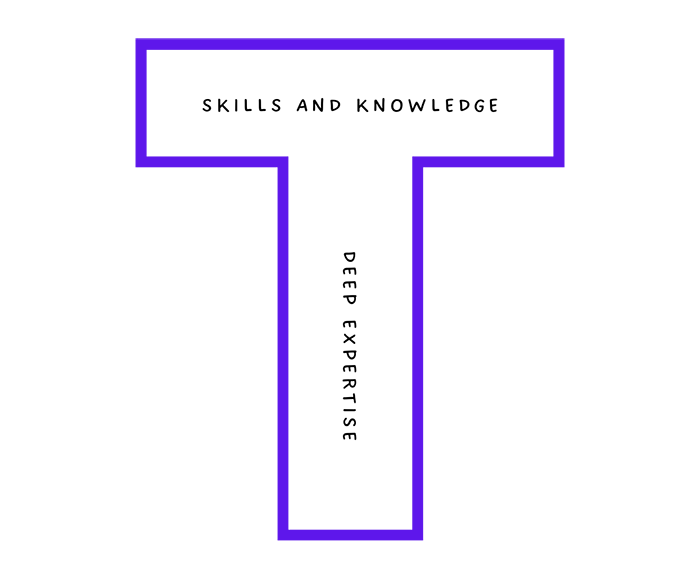
Employers value T-shaped people because they are adaptable and collaborative due to their range of experiences but can hone in on their speciality area.
In 2010 IDEO’s CEO, Tim Brown, said the concept of T-shaped people had influenced their approach to talent management as the vertical stroke of the ‘T’ aids innovation, and the horizontal stroke represented the ‘disposition for collaboration across disciplines’. In a nutshell, they are perfect members of a cross-functional team.
Other types of people include the I and the Pi (from the Greek letter π):

I-shaped individuals like research scientists or academics have deep and narrow expertise. Pi people have evolved to have two expertise points, adding greater career flexibility or capabilities: data scientists are a great example of this, blending statistical analysis and computer science.
The comb shape
However… It's 2023. And we are all about multi-hyphenates2, slashies and portfolio careers. Enter the comb-shaped person.
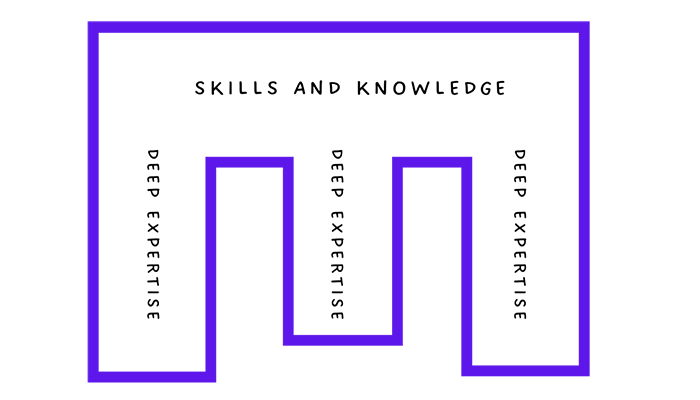
A comb-shaped person takes the T and adds to it with several points of expertise. For example, someone I know is a qualified solicitor and programmer with experience in financial markets and information security — making them a great candidate for consultancy.
The E shape
One recent development is the E-shaped individual. They have expertise in multiple areas but can also bring them together to create a holistic solution — in some models, this is represented as the four “Es” — experience + expertise + exploration + execution.
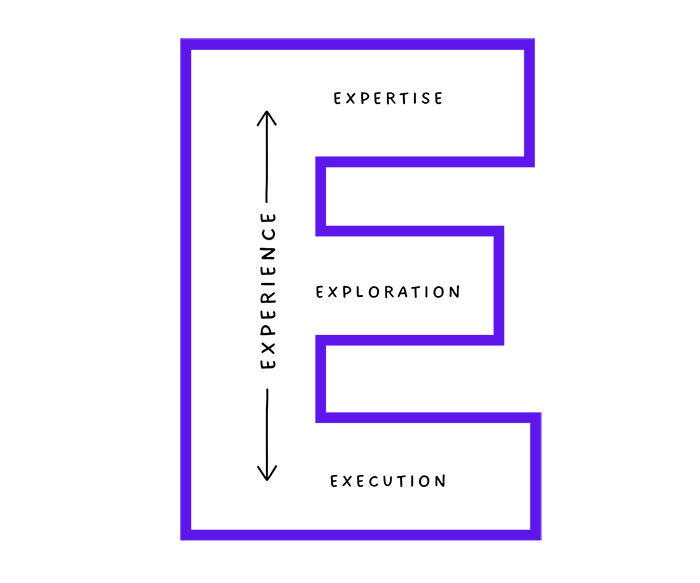
I suspect I’m more of an E than a comb. I have a base of core communication skills and a million useless facts, which I can combine with deep knowledge of consumer marketing, digital strategy and psychology. This approach has allowed me to pivot from lifestyle PR to banking services to the music industry.
A tip for both Es and Combs: ensure you can tell your career story concisely and persuasively to potential employers. How will this mélange of skills and experiences contribute to the current challenges?
Final thoughts
If you’re curious to find out what sort of “shape” you are, the following questions may help:
What areas of expertise do I already have a deep understanding of?
What fields or industries am I interested in or passionate about?
What skills or knowledge areas would I like to develop further?
How can I apply my skills and knowledge to collaborate with others from different fields or backgrounds?
How can I use my skills and knowledge to solve complex problems or challenges in my field or industry?
Ultimately, the best approach for you will depend on your interests, goals, and strengths. Of course, it’s never too late to change directions or develop a skill (for proof and a healthy dose of inspiration, check out the Guardian’s A New Start After 60 series).
Until next time,
Amber
Read What Colour Is Your Parachute, read Six Thinking Hats and watch a short explainer of the Color Code.
Fun fact: "multi-hyphenate" was coined in the 1970s to describe entertainers who advanced beyond the combination of acting, singing, and dancing.